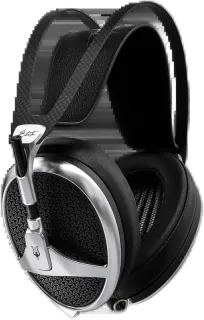
Two premium open-back planar headphones, the Erzetich Charybdis and the Meze Elite, both launched in 2021 and both ask for a small fortune. They share a lot on paper, but they are not the same headphone. This head-to-head works through what each offers, where they genuinely differ, and which one you should actually buy.
Price and positioning
The Charybdis costs $3000, the Elite $3400. That $400 gap is real but small relative to the total outlay. Both are firmly in the flagship tier, competing with other high-end planars rather than with anything remotely budget-friendly. The Charybdis uses a 115 mm planar magnetic driver, one of the largest you will find in a headphone. The Elite uses a hybrid driver array, though the exact configuration is not recorded in the HearWiki database. What both ask for is a dedicated headphone amplifier; neither is designed to run well from a phone or laptop.
Positioning differs in one clear way. Erzetich is a smaller Slovenian maker, and the Charybdis is their statement product. Meze is a more established brand with a known house sound, and the Elite sits at the top of their lineup. You are paying for engineering and materials in both cases, but the Charybdis leans toward a specialist, almost bespoke feel, while the Elite leans toward polished, repeatable luxury.
The scores, side by side
The HearWiki headline score for the Charybdis is 89/100. The Elite scores 81/100, rounded from 81.2. That is an eight-point gap, which is meaningful but not enormous. It is worth remembering that the headline score is a buyability score derived from published review consensus, price, and availability. It is not an average of the sub-scores, and in this case all sub-scores for both headphones are not recorded. So the gap reflects overall consensus and value perception, not a measured difference in sound quality.
Do not read too much into the difference. Both are well-reviewed flagship planars. The Charybdis simply appears to have generated slightly stronger consensus and a better perceived value at its lower price. If the Elite were $3000 and the Charybdis $3400, the scores might look different.
Sound
Neither headphone has recorded sub-scores for sound, so we rely on published reviews and the summary in the HearWiki database. The Meze Elite is described as refined, spacious, and highly musical, with strong technical performance, excellent detail retrieval, and a smooth tuning that remains detailed and dynamic. Its soundstage is spacious with excellent separation. The summary also notes potential bass roll-off, which may not suit bass-heavy listeners.
For the Charybdis, the database has no summary and no pros or cons recorded. What we know is the driver size: 115 mm planar magnetic. Large planar drivers typically produce low distortion and a fast, controlled bass response, but we cannot confirm how that translates to the Charybdis without published measurements. If you are choosing on sound alone, the Elite has a documented character: smooth, musical, and detailed, with a slight roll-off at the bottom. The Charybdis is more of an unknown quantity unless you read independent reviews.
Where they are close is in overall technical ability. Both are capable of resolving fine detail and presenting a wide, layered soundstage. The difference is likely in tuning philosophy. The Elite leans toward a natural, slightly warm presentation. The Charybdis, based on its driver design, may offer a more neutral or more extended bass response, but that is speculation, not a recorded fact.
Noise cancelling and battery
Neither headphone has active noise cancelling. The Charybdis has no ANC recorded, and the Elite has ANC listed as false. Both are wired-only, open-back designs, so they leak sound and let outside noise in. That is expected for this category, but it means neither is suitable for commuting, flights, or noisy offices.
Battery life is not recorded for either model, which makes sense because neither has a battery. They are passive wired headphones. There is no wireless operation, no Bluetooth, and no codec support. If you need ANC or wireless, these are the wrong products entirely.
Calls and everyday use
Call quality is not recorded for either headphone. Neither has a built-in microphone, and neither is designed for voice calls. You could plug in a separate mic cable, but that is not the intended use case. In everyday use, both are heavy, open-back, over-ear headphones that require a quiet room and a dedicated amplifier. Comfort is a strong point for the Elite, according to its recorded pros, which mention exceptional build quality and a comfortable fit. The Charybdis has no recorded comfort data, so we cannot compare directly.
Neither is portable. Both come with substantial packaging and cables, and both need careful handling. If you want a headphone to walk around with, look elsewhere. If you want a stationary listening rig, both work well.
Which one should you buy?
If you want a documented, proven flagship with a known sound signature and exceptional build quality, the Meze Elite is the safer choice. Its summary and pros are clear: spacious, musical, detailed, and comfortable. The main drawbacks are the higher price and the bass roll-off.
If you want something more distinctive, with a larger driver and a lower price, the Erzetich Charybdis is the more interesting option. It scores higher on the HearWiki buyability scale, and its $3000 price undercuts the Elite by $400. But you are buying into a smaller brand with less documented information in the database.
There is no single winner. The Elite is the better-documented, more conventional flagship. The Charybdis is the more adventurous choice with a better score and a lower price. Choose based on whether you value certainty or distinctiveness.
For a full side-by-side spec table, see the Charybdis vs Elite comparison. You can also browse other over-ear headphones or high-end options in the HearWiki database.
FAQ
Which is better, Erzetich Charybdis or Meze Elite?
The Charybdis has a higher HearWiki buyability score at 89/100 versus 81/100 for the Elite, and it costs $400 less. However, the Elite has more documented information about its sound signature and build quality. Neither is objectively better; it depends on whether you prefer a documented, musical tuning or a more distinctive, larger-driver design.
Are the Meze Elite good for bass-heavy music?
Published reviews note potential bass roll-off on the Elite, so it may not suit listeners who want strong sub-bass impact. The mid-bass and overall tonal balance are described as smooth and musical, but if you primarily listen to electronic or hip-hop, you might prefer a headphone with more low-end emphasis.
Do I need an amplifier for the Erzetich Charybdis or Meze Elite?
Yes, both are high-impedance planar headphones that require a dedicated headphone amplifier to perform properly. They are not designed to be driven by a phone, laptop, or basic dongle. Budget for a solid-state or tube amp when considering either purchase.{