Two premium true wireless earbuds sit close in price and ambition, but they aim at slightly different buyers. The Technics EAH-AZ100 and the JBL Live Beam 4 both cost around $250, both offer strong sound and active noise cancelling, and both have their own quirks. This head-to-head works through the published scores and specifications to help you decide which one fits your daily listening habits.
Price and positioning
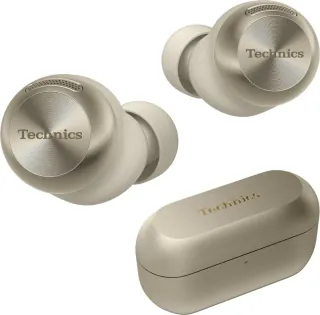
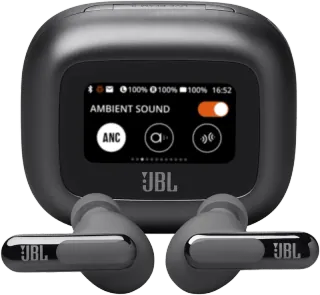
The Technics EAH-AZ100 launched in 2025 at $250. The JBL Live Beam 4 came out a year earlier at $240, a $10 difference that is effectively negligible. Both sit in the upper tier of true wireless earbuds, competing with the likes of Sony and Sennheiser rather than budget models. For that money, Technics leans on high-resolution audio support and refined tuning, while JBL leans on a feature list that includes a touchscreen case and a more rugged IP55 rating. Neither is a bargain, but both ask a similar premium for what they deliver.
The scores, side by side
HearWiki's headline buyability score for the Technics EAH-AZ100 is 86/100. The JBL Live Beam 4 scores 85/100. That one-point gap is effectively a tie, so don't read it as a clear win for either. The sub-scores tell a more nuanced story. Both earn 9.2/10 for sound. Technics leads on ANC at 8.6/10 versus 7.8/10, and on calls at 7.8/10 versus 6.8/10. JBL pulls ahead on battery at 9.0/10 versus 8.7/10, and slightly on value at 8.2/10 versus 8.1/10. The headline score is not a weighted average of these sub-scores, so the small gaps in each category don't directly sum to the overall difference.
Sound
Both earbuds use a 10 mm dynamic driver, and both earn the same 9.2/10 sound sub-score. Published reviews describe the Technics as rich and detailed, with support for LDAC streaming when your phone and source allow it. The JBL is described as lively and well-balanced, with punchy bass and clear highs. If you listen to lossless or high-bitrate files on an Android device, the Technics' LDAC support gives it a technical edge. The JBL does not list any codec information, so it's unclear whether it supports anything beyond the basics. In practice, most listeners will find both satisfying, but the Technics offers more headroom for those who care about source quality.
Noise cancelling and battery
Both have active noise cancelling. The Technics scores 8.6/10 for ANC, the JBL 7.8/10, a gap that suggests the Technics is more effective at quieting low-frequency rumble. The JBL's adaptive ANC works, but published reviews note it isn't the strongest in its class. Both also have transparency modes, so you can hear your surroundings when needed.
Battery figures are close. The Technics lists 12 hours per charge without ANC, 10 hours with ANC, and 28 hours total with the charging case. The JBL also lists 12 hours per charge without ANC and 10 hours with ANC, but its total with the case is not listed. Both support wireless charging, so topping up the case is easy. The JBL's touchscreen case adds a layer of control that the Technics doesn't offer, but that's a convenience feature rather than a battery advantage.
Calls and everyday use
Call quality is where the gap widens. The Technics scores 7.8/10 for calls, the JBL 6.8/10. The JBL has six microphones versus the Technics' two, but more mics don't automatically mean better clarity. Published reviews say the JBL's call quality is mediocre in noisy environments, while the Technics handles conversations more reliably. If you take calls on busy streets or in open offices, the Technics is the safer choice.
Both support multipoint, so neither gets credit for that feature over the other. Both also have wireless charging and transparency modes. The Technics adds wear detection, which pauses audio when you remove an earbud; the JBL does not list this feature. The JBL has a higher IP55 rating versus the Technics' IPX4, so it will shrug off more sweat and rain. The Technics is slightly heavier at 11.8 g per bud versus 9.7 g for the JBL, but both are comfortable for extended wear according to published reports.
Which one should you buy?
If you prioritise call clarity, effective noise cancelling, and high-resolution audio support, the Technics EAH-AZ100 is the better fit. It costs $10 more but delivers stronger ANC, better call performance, and LDAC for Android users. If you want a more rugged build, a touchscreen case, and a marginally higher battery score, the JBL Live Beam 4 is a compelling alternative, provided you can live with weaker call quality and less effective noise cancelling. For most people, the Technics edges ahead, but the JBL isn't far behind. See the full comparison table at /compare/technics-eah-az100-vs-jbl-live-beam-4 for a spec-by-spec breakdown.
FAQ
Do the Technics EAH-AZ100 support LDAC?
Yes, the Technics EAH-AZ100 support LDAC alongside SBC, AAC, and LC3. This allows high-resolution wireless audio on compatible Android devices. The JBL Live Beam 4 does not list its codec support.
Which earbuds have better call quality?
The Technics EAH-AZ100 score 7.8/10 for calls, while the JBL Live Beam 4 score 6.8/10. Published reviews note the JBL struggles in noisy environments, making the Technics the more reliable choice for phone calls.
Are the JBL Live Beam 4 waterproof?
The JBL Live Beam 4 have an IP55 rating, which means they resist dust and low-pressure water jets. The Technics EAH-AZ100 have an IPX4 rating, which covers sweat and light rain but not dust. Neither is fully waterproof.