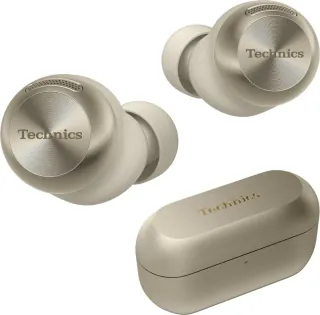
The Technics EAH-AZ100 and the Huawei FreeBuds Pro 5 are two serious contenders in the premium true wireless space, but they take different paths to get there. The Technics leans on a single large dynamic driver and long battery life, while the Huawei counters with a hybrid two-driver setup and a tougher IP57 rating. Neither is a clear knockout, so this head-to-head breaks down where each wins, where they tie, and which one fits your priorities.
Price and positioning
The Technics EAH-AZ100 asks $250, placing it firmly at the top end of the consumer TWS market. The Huawei FreeBuds Pro 5 undercuts that by $51, coming in at $199, which puts it in the upper-mid tier but still a premium ask. Both are positioned as flagship earbuds, but the price gap matters if you are watching your budget. The Technics justifies its higher price with LDAC support, multipoint for three devices, and a claimed 12-hour battery without ANC. The Huawei counters with Bluetooth 6.0, a hybrid driver array, and a wider frequency response, but its battery life is shorter, especially with ANC on.
The scores, side by side
In the HearWiki database, the Technics EAH-AZ100 holds a headline buyability score of 86/100, while the Huawei FreeBuds Pro 5 sits at 82/100. That is a four-point gap, which is real but not dramatic. The sub-scores tell a more nuanced story: the Technics leads clearly on sound (9.2 vs 8.6) and battery (8.7 vs 8.2), but the Huawei wins on calls (8.7 vs 7.8) and edges ahead on ANC (8.7 vs 8.6). Value is close, with the Technics at 8.1 and the Huawei at 8.3. The headline score is a buyability consensus, not a weighted average, so do not try to reverse-engineer it from the sub-scores. The practical takeaway is that both are well-regarded, but the Technics has a slight edge overall in the database's view.
Sound
Sound is where the Technics EAH-AZ100 makes its case. Its 10 mm dynamic driver, paired with LDAC and LC3 codecs, delivers a rich, detailed presentation that reviewers consistently describe as engaging and well-balanced. The sub-score of 9.2 is the highest in this comparison, and it shows in the consensus: the AZ100 is often praised for its bass control and midrange clarity. The Huawei FreeBuds Pro 5 uses a two-driver hybrid setup—a dynamic driver for lows and a separate driver for highs—which gives it a wide 10 Hz to 48 kHz frequency response. Its sound score of 8.6 is still strong, but reviews suggest it can sound slightly less cohesive than the Technics, with a brighter treble that some listeners may find fatiguing over long sessions. If you prioritise pure audio fidelity, the Technics is the safer bet. If you want a more analytical, detail-forward sound, the Huawei is worth considering, but only if you have a source that supports LDAC to get the most out of it.
Noise cancelling and battery
Noise cancelling is a near tie. The Huawei FreeBuds Pro 5 scores 8.7, just ahead of the Technics at 8.6. Published reviews indicate the Huawei's adaptive ANC is slightly more aggressive at silencing low-frequency rumble, which makes it a touch better on planes or trains. The Technics is not far behind, though, and its ANC is more natural-sounding to many ears, with less pressure buildup. Battery is a different story. The Technics EAH-AZ100 claims 12 hours without ANC and 10 with it, extending to 28 hours with the charging case. The Huawei FreeBuds Pro 5 manages 9 hours without ANC but drops to 5 with ANC on, and the total with the case is 33 hours. That is a significant gap: the Technics gives you nearly double the ANC-on runtime. If you are a heavy traveller or forget to charge your case, the Technics is the clear winner here.
Calls and everyday use
Call quality flips the script. The Huawei FreeBuds Pro 5 scores 8.7 for calls, well ahead of the Technics at 7.8. Reviews consistently note that the Huawei's microphone array handles windy conditions better and keeps your voice clear in noisy environments. The Technics is not bad, but it is noticeably weaker when there is background chatter or traffic. For everyday use, the Technics offers multipoint pairing for up to three devices, which is handy if you juggle a phone, laptop, and tablet. The Huawei sticks to two-device multipoint, which is fine but less flexible. The Huawei's IP57 rating is a big practical advantage: it is fully dust-tight and can survive submersion in water, whereas the Technics only has IPX4 sweat resistance. If you run in the rain or take calls in the gym, the Huawei is tougher. The Technics also does not include ear tips in the box, which is an odd omission at this price, so factor in the cost of aftermarket tips if you need a different size.
Which one should you buy?
Choose the Technics EAH-AZ100 if you care most about sound quality, battery life, and multipoint flexibility. It costs more, but you get a better audio experience, nearly double the ANC-on battery, and the ability to switch between three devices without re-pairing. It is the better all-rounder for long listening sessions and commutes.
Choose the Huawei FreeBuds Pro 5 if you take a lot of calls, need a rugged build, or want to save $51. Its call quality is clearly superior, the IP57 rating means you can wear it in heavy rain or at the gym without worry, and the ANC is marginally better. Just be prepared to charge more often, especially with ANC on.
If you are still undecided, the full comparison table at Technics EAH-AZ100 vs Huawei FreeBuds Pro 5 lays out every spec side by side. You can also read the individual reviews for the Technics EAH-AZ100 and the Huawei FreeBuds Pro 5 for more detail. For other options in this price range, browse our best true wireless list or the best ANC earbuds guide.
FAQ
Which earbuds have better battery life, Technics or Huawei?
The Technics EAH-AZ100 has significantly better battery life, offering 12 hours without ANC and 10 with it, versus the Huawei FreeBuds Pro 5's 9 hours without ANC and 5 with it. The Technics also extends to 28 hours with the case, while the Huawei reaches 33 hours with its case.
Are the Huawei FreeBuds Pro 5 good for phone calls?
Yes, the Huawei FreeBuds Pro 5 score 8.7/10 for calls, which is higher than the Technics EAH-AZ100's 7.8/10. Published reviews highlight its strong microphone performance in windy and noisy conditions, making it a better choice for frequent callers.
Do the Technics EAH-AZ100 support LDAC?
Yes, the Technics EAH-AZ100 supports LDAC, along with SBC, AAC, and LC3 codecs. This allows high-resolution audio streaming on compatible Android devices, which is a key advantage for audiophiles.