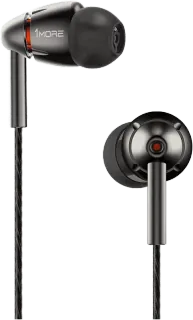
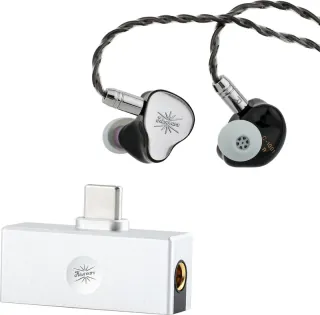
Two wired hybrid IEMs sit close in price and score, but they ask very different things from you. The Sivga Lyrebird wants a balanced amplifier and a 4.4mm adapter; the 1MORE H1012 just wants to be plugged in. This head-to-head uses only the recorded data to show where they genuinely overlap and where they diverge.
Price and positioning
The Sivga Lyrebird costs $149. That puts it in the upper tier of wired IEMs, where you are paying for driver count, build, and a specific tuning philosophy. The 1MORE H1012 costs $88, which is a more accessible price for a hybrid with a similar driver concept. The Lyrebird uses a 4-driver hybrid setup; the H1012 uses a 1DD + 2BA hybrid. Neither price includes a wireless option, and neither has noise cancelling.
What you are really paying for with the Lyrebird is the balanced connection and the wider soundstage it enables, provided you have the gear. The H1012 asks less of you upfront: it is cheaper and does not require an adapter or amp to reach its baseline performance. That difference in entry cost is not just about the sticker price; it is about the total cost of ownership.
The scores, side by side
The HearWiki scores are closer than the price gap suggests. The Sivga Lyrebird scores 80/100, and the 1MORE H1012 scores 80/100. The recorded scores are identical, so this is a tie rather than a meaningful ranking difference. Both earn a sound sub-score of 8.5/10 and a value sub-score of 8/10. The other sub-scores - ANC, battery, and calls - are not recorded for either product, because neither has those features or the data was not supplied.
Do not read a one-point gap as a meaningful ranking. It is within the margin of error for subjective audio evaluation. The scores tell you these are comparable performers, not that one is clearly better. For a full breakdown, see the comparison table.
Sound
Both IEMs share the same sound sub-score, but they achieve it differently. The Sivga Lyrebird is described as detailed and energetic, with excellent separation and imaging. Its soundstage is wide, and the treble is smooth. The trade-off is that its sub-bass depth could be stronger, and its tuning may not suit heavier genres like metal or hard rock, where you want more low-end slam.
The 1MORE H1012 takes a more balanced, clean approach. It is tuned for critical listening across most genres, with clarity as the priority. Its low-bass impact is limited, and the soundstage feels narrow because of the in-ear fit. So you are choosing between width and neutrality. The Lyrebird gives you space and separation; the H1012 gives you balance and consistency.
Neither is a basshead IEM. If you want deep sub-bass, look elsewhere. If you want a clear, detailed presentation, both deliver, but the Lyrebird needs a capable amp to show its full potential. The H1012 is more forgiving of a basic phone or laptop jack.
Noise cancelling and battery
Neither product has active noise cancelling. The ANC sub-score is null for both, meaning it is not recorded because the feature does not exist. Both are wired, so there is no battery, no Bluetooth, and no codec support. The battery sub-score is also null for both. If you need wireless freedom or ANC, these are not the products for you. They are for listening sessions where you can sit still and plug in.
Calls and everyday use
Call quality is not recorded for either product, and neither has a microphone specification in the data. In practice, wired IEMs without an inline mic are not ideal for calls, but the data does not confirm whether either includes a cable with a mic. The Lyrebird's 4.4mm balanced plug is the bigger everyday issue: most phones and laptops use 3.5mm, so you will need an adapter or a dedicated amp. The H1012 is more plug-and-play, which makes it easier for daily use on the go.
Build quality is strong on both. The Lyrebird is described as comfortable and premium; the H1012 as sturdy and premium. The H1012 also comes with a generous accessory bundle, which adds practical value. If you want something you can grab and use without thinking, the H1012 is the better everyday companion. If you have a desk setup with a balanced amp, the Lyrebird fits that workflow better.
Which one should you buy?
Buy the Sivga Lyrebird if you already own a balanced amplifier or are willing to buy an adapter, and if you prioritise soundstage width and instrument separation over bass weight. It is the better choice for gaming and for acoustic or orchestral music, where imaging matters.
Buy the 1MORE H1012 if you want a lower entry price, a more neutral tuning, and a simpler connection. It suits critical listening across genres, and its accessory bundle means you do not need to buy extra cables or tips. If you are not sure whether you will invest in a dedicated amp, the H1012 is the safer bet.
If you are torn, consider your gear first. The Lyrebird is not a bad IEM, but it is a demanding one. The H1012 rewards you immediately with less fuss. Both are good values at their respective prices; the difference is what you bring to the table.
For more context, browse the wired IEM ranking or filter the full headphone database.\n\n## FAQ
Does the Sivga Lyrebird work with a phone?
Only if your phone has a 4.4mm balanced output, which is rare. You will need a 4.4mm to 3.5mm adapter or a USB-C dongle with a balanced output. Without an adapter, the Lyrebird will not connect to most phones.
Which IEM has better bass, the Lyrebird or the H1012?
Neither is a bass-heavy IEM. The Lyrebird has stronger sub-bass presence than the H1012, but its depth is still limited. The H1012 has even less low-bass impact, so if bass is your priority, look for a dedicated bass IEM instead.
Are these IEMs good for gaming?
The Sivga Lyrebird is the better gaming choice because of its wide soundstage and imaging, which help with positional audio. The 1MORE H1012 is more neutral but has a narrower stage, so it is less ideal for competitive gaming. Both are wired, so there is no latency issue.