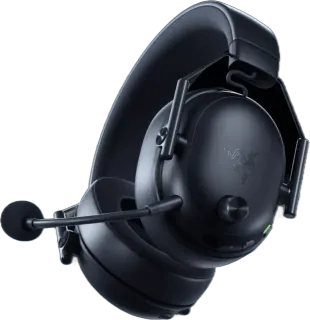
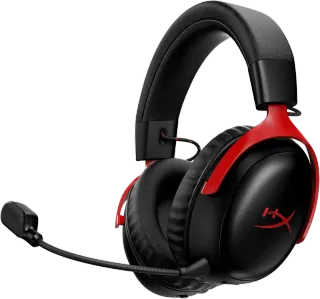
Two wireless gaming headsets launched in 2025, both aiming for the same spot on your desk. The Razer BlackShark V3 and the HyperX Cloud III S Wireless are close in price, close in intent, but different in what they prioritise. Here is how they actually compare, based on published reviews and recorded specifications.
Price and positioning
The Razer BlackShark V3 costs $125. The HyperX Cloud III S Wireless costs $140. That $15 gap is small, but it buys you different things. Razer puts its money into a lightweight 270g frame and multipoint Bluetooth 5.3, so you can hop between your PC and phone without re-pairing. HyperX spends it on a larger 53mm driver, dual wireless (2.4GHz plus Bluetooth 5.3), and a detachable mic with two microphone elements. Neither headset has active noise cancellation, so both rely on passive isolation from their earcups.
The scores, side by side
HearWiki's headline score is a buyability rating based on review consensus, price, and availability. The Razer BlackShark V3 scores 91/100. The HyperX Cloud III S Wireless scores 82/100. That is a nine-point gap, which is meaningful, but it is not a landslide. Look at the sub-scores and the picture gets more nuanced. On sound, Razer leads 9.2/10 to 8.2/10. On calls, Razer leads 8.8/10 to 8.0/10. On value, Razer leads 9.2/10 to 8.8/10. But on battery, HyperX wins clearly: 9.8/10 versus 8.6/10. Neither headset has an ANC sub-score because neither has active noise cancellation; that field is not listed for either product.
Sound
The Razer BlackShark V3 uses 50mm dynamic drivers at 32 ohms. The HyperX Cloud III S Wireless uses 53mm dynamic drivers at 64 ohms. Bigger drivers do not automatically mean better sound, and the published sub-scores reflect that. Razer's 9.2/10 sound score is a step above HyperX's 8.2/10. Reviews describe the BlackShark V3 as having robust, well-balanced audio that works for both gaming and music. The Cloud III S Wireless is tuned more for gaming than critical listening, which is fine if you only play shooters, but less versatile if you also watch films or listen to albums. Both support SBC and AAC codecs over Bluetooth 5.3, so neither gets a codec advantage.
Noise cancelling and battery
Neither headset has active noise cancellation. If you need to block out a noisy room, you are relying on the passive seal of the earcups. The Razer BlackShark V3 has no ANC, no water resistance rating, and no wireless charging. The HyperX Cloud III S Wireless also has no ANC, no water resistance rating, and no wireless charging. On transparency mode, wear detection, and IP rating, neither product lists a figure, so do not assume either has them.
Battery is where the two diverge. The Razer BlackShark V3 is rated at 70 hours per charge. The HyperX Cloud III S Wireless is rated at 120 hours per charge. That is a huge difference, and it is the main reason HyperX's battery sub-score is 9.8/10 versus Razer's 8.6/10. Note that the 120-hour figure is per charge, not with a charging case, because neither headset ships with a case. Some published reviews note that the HyperX's measured battery life may fall slightly below its headline claim, but even a 100-hour real-world result would still crush the Razer's 70-hour rating.
Calls and everyday use
The Razer BlackShark V3 has one microphone with noise cancellation. The HyperX Cloud III S Wireless has two microphone elements and a detachable boom mic. Despite having fewer mic elements, the Razer scores higher on calls: 8.8/10 versus 8.0/10. The Razer's single mic is a noise-cancelling design, and the sub-scores suggest it keeps your voice cleaner in practice; mic count alone does not decide call quality.
For everyday use, the Razer is lighter at 270g versus the HyperX's 358.3g. That 88g difference is noticeable over a long session. The Razer also has multipoint Bluetooth, so you can connect to your PC and phone at the same time. The HyperX does not support multipoint; you have to switch manually between the 2.4GHz dongle and Bluetooth. If you frequently take calls while gaming, the Razer is the easier daily driver. If you only ever sit at one desk, the HyperX's dual wireless is fine.
Which one should you buy?
Buy the Razer BlackShark V3 if you want the better all-round package: lighter build, better sound, better mic, multipoint, and a lower price. It is the safer recommendation for most people, and its 91/100 headline score reflects that.
Buy the HyperX Cloud III S Wireless if battery life is your absolute priority. A 120-hour rating means you can forget about charging for weeks, and the dual wireless is handy if you want a low-latency 2.4GHz connection for gaming plus Bluetooth for your phone. You give up multipoint, a bit of sound quality, and you carry an extra 88g on your head.
For a full breakdown of every spec and sub-score, see the comparison table. If you are still deciding between several models, our best gaming headsets guide may help narrow it down.
FAQ
Which gaming headset has better battery life, Razer BlackShark V3 or HyperX Cloud III S Wireless?
The HyperX Cloud III S Wireless has a much longer rated battery life at 120 hours per charge, compared to the Razer BlackShark V3's 70 hours. If you hate charging your headset, the HyperX is the clear winner here.
Do the Razer BlackShark V3 and HyperX Cloud III S Wireless have active noise cancellation?
No, neither headset has active noise cancellation. Both rely on passive isolation from their earcups, which blocks some background noise but does not actively cancel it. If ANC is essential, you should look elsewhere.
Can I use the Razer BlackShark V3 with my phone and PC at the same time?
Yes, the Razer BlackShark V3 supports multipoint Bluetooth 5.3, so you can connect it to two devices simultaneously. The HyperX Cloud III S Wireless does not support multipoint, so you would need to switch between the 2.4GHz dongle and Bluetooth manually.