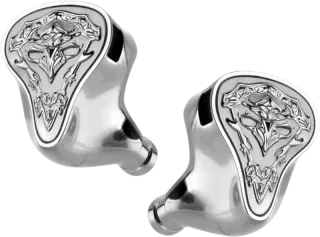
Two flagship tribrid IEMs, two very different tunings, and a $1,000 price gap. The FiiO FX17 and Kinera Thorking both pack dynamic drivers, balanced armatures, and electrostatic drivers into premium shells, but they ask very different things from your source and your ears. Here is how they stack up on published reviews and recorded specifications.
Price and positioning
The FiiO FX17 costs $1499, while the Kinera Thorking costs $2499. That is a $1,000 difference, and it puts the Thorking in a different tier of expectation. FiiO positions the FX17 as a versatile, high-resolution tribrid with a titanium shell and a five-way crossover. Kinera positions the Thorking as a reference-style, treble-forward flagship aimed at listeners who prioritise air and detail over warmth.
Neither is a budget product, but the FX17 is the more accessible of the two, both in price and in the source requirements. The FX17 has a 16-ohm impedance; the Thorking is 10 ohms. Lower impedance can mean more sensitivity to source output impedance, so the Thorking may be pickier about what you plug it into. HearWiki has no figure for the Thorking's weight, but the FX17 weighs 12.2g per side.
The scores, side by side
The headline HearWiki score for the FiiO FX17 is 83/100. The Kinera Thorking scores 81/100. That two-point gap is effectively a tie in buyability terms. The FX17 edges ahead on price and value; the Thorking edges ahead on raw sound sub-score, 9.2/10 versus 9.0/10. Neither score is a weighted average of the sub-scores, so do not try to reverse-engineer the headline from the categories.
Both products have a value sub-score of 6.0/10. That is not a ringing endorsement for either at these prices, but it reflects that both are competing in a crowded flagship market where diminishing returns set in hard. The FX17's lower price gives it a slight practical advantage, but the Thorking's sound sub-score shows that published reviews regard its technical performance highly.
Sound
The FX17 uses a 1DD + 4BA + 8EST tribrid array per side. Published reviews describe it as detailed and multi-layered, with expansive treble and dynamic bass. The five-way crossover is meant to integrate those eleven drivers per side into a coherent whole. The Thorking uses a 1DD + 6BA + 4EST array, also eleven drivers per side, but with a treble-forward, reference tuning. Reviews highlight excellent treble extension, airiness, precise imaging, and a natural midrange. They also note lean bass and lower midrange, which may come across as dry or lacking warmth.
If you listen to classical, acoustic, or treble-heavy genres, the Thorking's transparency will likely appeal. If you want a more balanced, bass-present signature that still retrieves detail, the FX17 is the safer bet. Neither is a basshead IEM. The Thorking's lean low end is a known characteristic; the FX17's dynamic driver gives it more low-end presence, but it is not a bass cannon either.
Both are tribrids, so both demand a clean source. The FX17's 16-ohm impedance is manageable with most dongles; the Thorking's 10-ohm impedance may benefit from a low-output-impedance source to avoid altering its tuning. For a deeper look at how they compare on paper, see the full comparison table.
Noise cancelling and battery
Neither the FX17 nor the Thorking has active noise cancellation. Both are wired IEMs with no Bluetooth, so there is no ANC, no transparency mode, and no battery to speak of. HearWiki lists no battery hours for either product, and no battery life with a charging case, because neither has a case with a battery. If you need isolation, you will rely on the physical seal of the ear tips. If you need wireless, neither of these is the product for you. For that, you would be looking at our best true wireless or best ANC earbuds lists.
Calls and everyday use
Neither product lists a microphone count, so call quality is not a documented strength for either. Both are wired, so you would need a cable with an inline mic to take calls, and neither lists one. For everyday use, the FX17's swappable plugs on its cable offer flexibility across balanced and single-ended sources. The Thorking uses a detachable 2-pin 0.78 mm cable and also supports balanced connections.
Neither has an IP rating listed, so do not assume water or sweat resistance. Neither supports multipoint, wireless charging, or wear detection, because those features require a wireless connection and neither has one. If you want a wired IEM for desk listening, both are fine. If you want something for commuting with calls and battery, look elsewhere, perhaps at our best over-ear or best budget earbuds under 50 lists for more practical options.
Which one should you buy?
Buy the FiiO FX17 if you want a premium tribrid that balances detail with a fuller low end, and if you want to save $1,000 while still getting a flagship-level driver array. Its titanium shell and swappable plugs make it a versatile daily driver for a wired setup.
Buy the Kinera Thorking if you are a treble enthusiast, listen mostly to classical or acoustic music, and already own a warm or neutral source that can handle a 10-ohm load. Its reference tuning rewards patient listening but punishes bass-heavy genres and bright sources.
If you cannot decide between the two, the FX17 is the more broadly appealing choice. The Thorking is a specialist tool for a specific taste. Both are excellent on paper, but they are not interchangeable.
FAQ
Are the FiiO FX17 and Kinera Thorking wireless?
No, both are wired IEMs. They have no Bluetooth, no battery, and no active noise cancellation. You will need a wired source and a good seal from the ear tips for isolation.
Which IEM has better bass, the FX17 or the Thorking?
The FiiO FX17 has a dynamic driver and published reviews describe its bass as dynamic. The Kinera Thorking is treble-forward with lean bass and lower midrange, so it is not for bassheads. If low-end presence matters, choose the FX17.
Is the Kinera Thorking worth $1,000 more than the FiiO FX17?
Probably not for most buyers. The headline scores are within two points, and the value sub-scores are identical at 6.0/10. The Thorking has a slightly higher sound sub-score, but the FX17 costs $1,000 less and offers a more balanced tuning.