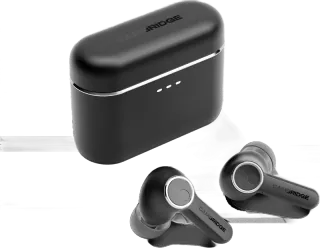
The Cambridge Audio Melomania A100 and the Realme Buds Air8 Pro are two true wireless earbuds that ask different questions. One leans on audiophile codecs and a long battery; the other packs hybrid drivers and aggressive value. Both have active noise cancellation, both cost under $100, and both score within two points on the HearWiki buyability scale. This head-to-head works through where they genuinely differ and where they are closer than the marketing suggests.
Price and positioning
The Cambridge Audio Melomania A100 costs $99. That places it at the top of the budget tier, but it brings aptX Lossless, LDAC, and a 10 mm dynamic driver. The Realme Buds Air8 Pro costs $74, which is $25 less. Realme positions it as a feature-dense option with a hybrid dual-driver setup and Bluetooth 6.1.
Neither is a luxury buy. The Melomania A100 asks you to pay for codec support and a trusted audio brand. The Realme asks you to trust a newer spec sheet and a lower price. If you already own a phone that supports LDAC or aptX Adaptive, the Cambridge pair justifies its premium. If you mostly stream from a standard phone or laptop, the Realme covers the basics for less.
The scores, side by side
HearWiki's headline score is a buyability rating based on published review consensus, price, and availability. The Melomania A100 scores 86/100. The Realme Buds Air8 Pro scores 84/100. That two-point gap is small enough that you should not treat it as a decisive factor.
The sub-scores tell a more nuanced story. On sound, the Cambridge pair gets 9/10 against Realme's 8.4/10. On noise cancelling, Realme actually edges ahead: 8.4/10 versus 7.8/10. Battery favours Cambridge at 8.5/10 versus 7.2/10. Calls are nearly identical: 8/10 for Cambridge, 8.5/10 for Realme. Value is close too: 9.6/10 for Cambridge, 9.2/10 for Realme.
So the headline gap is small, but the sub-scores show each pair winning in different areas. Do not treat the headline as a weighted average of those sub-scores; it is a separate buyability figure. The real question is which sub-scores matter more to you.
Sound
Cambridge Audio's Melomania A100 supports SBC, AAC, aptX Adaptive, aptX Lossless, and LDAC. That is a rare list at this price. If your source device can send LDAC or aptX Lossless, you get a genuinely high-resolution path. The 10 mm dynamic driver is a single, well-tuned unit, and the companion app includes a custom EQ.
The Realme Buds Air8 Pro uses a hybrid dual-driver setup. It supports SBC, AAC, and LHDC. LHDC is capable of high bitrates, but support is less common than LDAC. Reviewers note that the best sound requires manual tuning, which suggests the default tuning is not the final word.
In practice, the Cambridge pair should give you more detail and refinement out of the box, especially with a compatible phone. The Realme pair can sound good, but you will need to spend time in the EQ to get there. If you are a passive listener who never touches EQ, the Cambridge pair is the safer choice. If you enjoy tweaking, the Realme's hybrid drivers offer a different flavour.
Noise cancelling and battery
Both pairs have active noise cancellation. The Melomania A100 uses adaptive ANC that adjusts to your surroundings; it scores 7.8/10. The Realme Buds Air8 Pro also has adaptive ANC and scores higher at 8.4/10. That is a meaningful difference if you commute on loud trains or work in a noisy open-plan office.
Battery is where the gap flips. The Cambridge pair claims 11 hours with ANC off and about 6.5 hours with ANC on, so noise cancelling costs it a large chunk of runtime. The Realme claims 12 hours, but scores lower on battery at 7.2/10, likely because real-world usage falls short of that figure. The Cambridge case supports wireless charging; the Realme has no wireless charging at all.
So the trade-off is clear: the Realme gives you better noise cancelling, the Cambridge gives you better battery endurance when you turn ANC off. If you rarely use ANC and want all-day battery, the Cambridge pair wins. If you need strong ANC for a commute, the Realme is the better tool.
Calls and everyday use
Call quality is nearly a tie. The Cambridge pair scores 8/10, the Realme scores 8.5/10. The Realme's microphone array is credited with clear call quality in reviews. The Cambridge pair is solid but not outstanding for calls.
Both support multipoint. The Realme supports up to three devices; Cambridge lists multipoint without specifying a device count. The Cambridge pair is rated IPX5 and the Realme IP55, so sweat and light rain are fine for both, and the Realme adds dust protection. Both use touch controls; the Cambridge's can be over-sensitive, while the Realme's take some getting used to.
For everyday use, the Realme feels more modern on paper: Bluetooth 6.1 versus 5.4, a higher call score, and stronger ANC. The Cambridge pair counters with better codecs and a longer battery. Neither is a clear all-rounder.
Which one should you buy?
Choose the Cambridge Audio Melomania A100 if you have a phone that supports LDAC or aptX Lossless, if you value sound quality above all, and if you can live with slightly weaker ANC. It also suits you if you want a long battery life with ANC off and appreciate a trusted audio brand.
Choose the Realme Buds Air8 Pro if you want stronger noise cancelling, better call quality, and a lower price. It is the better pick for commuters and office workers who care more about blocking out the world than about codec purity. It is also the better value if you are not an audiophile and just want a reliable, feature-rich pair under $80.
If you are still undecided, the full comparison table is at /compare/cambridge-audio-melomania-a100-vs-realme-buds-air8-pro. For more options in this price range, see our best budget earbuds under $50 and best earbuds under $100 guides.
FAQ
Which earbuds have better sound quality, Melomania A100 or Buds Air8 Pro?
The Cambridge Audio Melomania A100 scores higher on sound at 9/10 versus 8.4/10 for the Realme. The Cambridge pair also supports LDAC and aptX Lossless, which can deliver more detail if your phone supports those codecs. The Realme can sound good, but it requires manual EQ tuning to get there.
Do the Realme Buds Air8 Pro have better noise cancelling than the Melomania A100?
Yes, based on the recorded sub-scores. The Realme Buds Air8 Pro scores 8.4/10 for ANC, while the Cambridge Audio Melomania A100 scores 7.8/10. Both use adaptive noise cancellation, but the Realme is rated higher for blocking out background noise.
Which earbuds have longer battery life?
The Cambridge Audio Melomania A100 claims 11 hours with ANC off and scores 8.5/10 on battery. The Realme Buds Air8 Pro claims 12 hours but scores lower at 7.2/10, suggesting real-world performance may not match the claim. The Cambridge pair also supports wireless charging, which the Realme does not.