Impedance is one of the most quoted headphone specifications, but it is often discussed without context. It describes an electrical relationship, not whether a headphone sounds good.
You do not need to memorise formulas to buy sensibly. You need to understand why impedance and sensitivity belong together, what a source can deliver, and when an amplifier may help.
What impedance means
Impedance is measured in ohms and describes how strongly a headphone opposes an alternating audio signal. It can vary with frequency, so the number printed on a box is a nominal value rather than the whole story.
A higher impedance model generally needs more voltage to reach a given level. A low impedance model may draw more current. Neither is automatically difficult: the result depends on sensitivity and on the output capability of the phone, dongle, laptop, interface or amplifier.
This is why a rule such as "anything above 32 ohms needs an amp" is unreliable. Some high impedance headphones are sensitive, while some low impedance planar models need substantial power.
Sensitivity completes the picture
Sensitivity tells you how loudly a headphone plays for a specified amount of voltage or power. Manufacturers do not always publish it in the same unit, but it is essential context.
Two headphones with the same impedance can require very different volume settings. The Sennheiser HD 650, an 85/100 wired over-ear in HearWiki, is often paired with desktop equipment. That does not mean every listener needs an expensive amplifier. Test whether your source reaches a comfortable level cleanly, with some headroom.
What an amplifier can fix
An amplifier supplies the voltage and current needed to drive headphones. If a source runs out of headroom, peaks may distort or the maximum level may be too low. A suitable amplifier solves that problem.
It does not repair poor tuning, add missing recording detail or transform one driver into another. Once a clean source provides adequate power at low output impedance, gains tend to be smaller than changing the headphone itself. Compare at matched loudness, because a slightly louder signal is commonly perceived as fuller or clearer.
Output impedance and sensitive IEMs
The source has its own output impedance. If that value is high relative to the headphone load, it can alter frequency response, especially with multi-driver earphones.
Most modern dongles and solid-state outputs have low output impedance. Sensitive IEMs present a different problem: they may reveal background hiss from a noisy source. More power is not the cure; a quieter output with appropriate gain is.
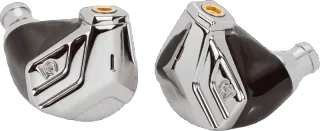
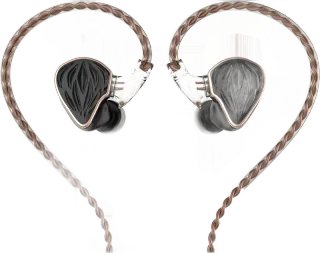
The Moondrop DUSK is a wired IEM scored at 84/100. Like every IEM, it should be judged on fit, tuning and practical source compatibility rather than impedance alone. Browse the wired IEM ranking for alternatives.
Do you need a DAC?
A DAC converts digital audio into an analogue signal; an amplifier raises that signal to drive the headphone. A dongle or desktop unit often combines both.
You need an external DAC when the device lacks an analogue output, its output is noisy or faulty, or you need extra inputs. Buying a premium DAC purely because a headphone has high impedance does not follow. Power comes from the amplifier stage.
Try your current source at normal volume. If you have headroom, no hiss and no distortion, there may be nothing to fix. Use the comparison tool to compare headphones, and read how the HearWiki score works before treating any single number as a verdict.
FAQ
Does higher impedance mean better sound?
No. Impedance is an electrical characteristic, not a quality score.
Will an amplifier make headphones louder?
Yes, if it supplies more clean voltage or current. That only matters when the existing source is inadequate.
Can a phone drive wired headphones?
Often yes, usually through a small adapter. Demanding models may need more power, so check both impedance and sensitivity.