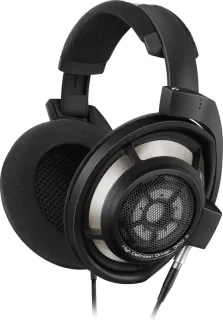
Two of the most respected open-back headphones on the market, the Sennheiser HD 800 S and the Focal Clear, both earn an 88/100 HearWiki score. That shared number hides real differences in tuning, amplification needs, and price. This editorial walks through the data we have, not the marketing, so you can decide which flagship fits your setup and your ears.
Neither pair is wireless, neither has active noise cancelling, and neither records a battery life. Both are wired, open-back, dynamic-driver designs aimed at serious home listening. The comparison starts with what each asks for upfront and what it expects from the rest of your chain.
Price and positioning
The Sennheiser HD 800 S is listed at $1000. The Focal Clear is listed at $1500. That is a $500 gap, which is not trivial, but both sit in the premium tier of wired over-ears. Neither is a budget purchase, and both assume you already own or plan to buy a decent amplifier.
The HD 800 S is a 2016 refinement of the original HD 800. It keeps the wide soundstage and high-impedance dynamic drivers that made the original a reference in studios and living rooms. The Focal Clear does not have a recorded release year in our database, so we cannot say how it dates relative to the Sennheiser. What we can say is that the Clear is Focal's more forgiving take on its own flagship sound, often described as less demanding of amplification than the HD 800 S.
Positioning matters here. The HD 800 S is a tool for critical listening, transparent to the point of exposing flaws in poor recordings. The Clear is also transparent, but it tends to add a touch of warmth and punch that makes it more forgiving of average files. Neither is a casual headphone, but the Clear is the easier daily companion.
The scores, side by side
Both headphones score 88/100 overall. That is not a rounding trick; the two sit at the same headline level. The subscores tell a slightly different story.
The HD 800 S earns 9.5/10 for sound, the highest sub-score in this comparison. The Focal Clear earns 9/10 for sound. That half-point gap is small but real. It reflects the Sennheiser's edge in detail retrieval and soundstage width, which are its defining traits.
On value, the Focal Clear scores 7/10 against the HD 800 S's 6.5/10. That makes sense given the price difference in the other direction. The Clear costs more but scores higher on value, which suggests its warmer tuning and easier amplification make it a more practical buy for more people. The HD 800 S's lower value score reflects its higher demands on the rest of your chain.
For noise cancelling, battery, and calls, both headphones have null subscores. That means we have no recorded data for those features, and given the wired, open-back design, that is expected. Do not read a null as a failure; read it as a feature that does not exist here.
Sound
Sound is where these two diverge most clearly. The HD 800 S is the more neutral and spacious of the pair. Its soundstage is exceptionally wide, which makes orchestral music and live recordings feel vast. Detail retrieval is top-tier: you will hear reverb tails, chair creaks, and mastering artifacts that cheaper headphones hide. The treble is present and extended, though some listeners find it slightly bright on poorly mastered tracks.
The Focal Clear is more intimate and more dynamic in the lower frequencies. Its bass has more slam and body, and its midrange is slightly forward, which makes vocals feel closer and more immediate. It is not as wide as the HD 800 S, but it is more engaging for rock, pop, and electronic. The Clear's treble is smoother, so it is less likely to fatigue you over a long session.
Both are excellent. The choice is between the Sennheiser's reference neutrality and the Focal's musicality. If you want to hear everything in a recording, the HD 800 S. If you want to feel the rhythm and enjoy the song, the Clear. Neither is wrong, and neither is a clear winner on sound alone.
Noise cancelling and battery
Neither headphone has active noise cancelling. Both are open-back, so they leak sound out and let ambient noise in. That is by design. Do not buy either for a commute, an office, or a flight. They are for quiet rooms and dedicated listening sessions.
Battery life is not recorded for either model because neither has a battery. They are wired and passive. You plug them into an amplifier or a DAC and they work. There is nothing to charge, which is either a relief or a dealbreaker depending on your habits. If you need wireless or ANC, look elsewhere in our best over-ear guide or our best ANC earbuds list.
Calls and everyday use
Call quality is not recorded for either headphone. That is consistent with their design. Neither has a microphone in the cable by default, and neither is intended for phone calls. If you need a headset for calls, these are not it. You would be better served by a dedicated gaming headset or a wireless pair with a built-in mic.
Everyday use is also limited. Both are large, open-back, over-ear designs. They are comfortable for long sessions, but they are not portable. There is no folding mechanism, no carrying case in the box that we can confirm, and no Bluetooth. They stay on a desk or a headphone stand. If you want something you can take to a café, look at our best true wireless list instead.
Which one should you buy?
Buy the Sennheiser HD 800 S if you already have a high-quality amplifier and you want the most revealing, widest-sounding headphone in this price range. You will pay $1000, but you will get a 9.5/10 sound score and a reference tuning that works for critical listening, mixing, and classical music. Accept that you will need to spend more on amplification to hear what it can do.
Buy the Focal Clear if you want a flagship that is easier to enjoy out of the box. At $1500, it costs more, but it scores higher on value at 7/10 because it works better with a wider range of amplifiers, including many solid-state and tube amps. Its warmer, punchier sound suits rock, pop, and electronic, and it is less likely to fatigue you over a long evening.
If you are torn, the deciding factor is your amplifier and your music library. The HD 800 S rewards a transparent, powerful chain. The Clear rewards a more forgiving one. Both are 88/100 headphones, and you will not be disappointed with either. For a side-by-side spec table, see our full comparison.
FAQ
Do the Sennheiser HD 800 S need an amplifier?
Yes. The HD 800 S is a high-impedance headphone that needs a dedicated amplifier to reach its full potential. A laptop or phone jack will drive them to a reasonable volume, but the sound will be thin and lacking in dynamics. Plan for a separate amp or a high-quality DAC in your budget.
Is the Focal Clear worth the extra $500 over the HD 800 S?
It depends on your setup. The Clear costs $500 more but scores higher on value because it is easier to drive and more forgiving of average recordings. If you already own a good amp, the HD 800 S offers more detail for less money. If you are starting fresh, the Clear may save you money on amplification in the long run.
Which is better for classical music, the HD 800 S or the Focal Clear?
The HD 800 S is the better choice for classical music. Its wider soundstage and more neutral tuning let orchestral instruments breathe and maintain their natural spatial relationships. The Focal Clear is more intimate and warmer, which can make large ensembles sound slightly compressed by comparison. For solo piano or small jazz groups, the Clear's midrange warmth is lovely, but for full orchestras, the Sennheiser wins.